I’ve been building and fixing revenue stacks since the days when “marketing automation” meant Eloqua, a six-figure contract, and a consultant who lived in your Cognos reports. I’ve watched the Predictable Revenue era mint a generation of SDR teams, watched ZoomInfo become a tax on B2B, and watched Marketo get bought twice.
So when a chart like this circulates — 2022 stack on the left, 2026 stack on the right, tidy arrows in between — I read it differently than most people do. Most people read it as a shopping list. It isn’t. It’s a picture of an industry that got taken apart.
Let me tell you what actually happened underneath those logos, and what it means if you’re a founder still doing your own sales.
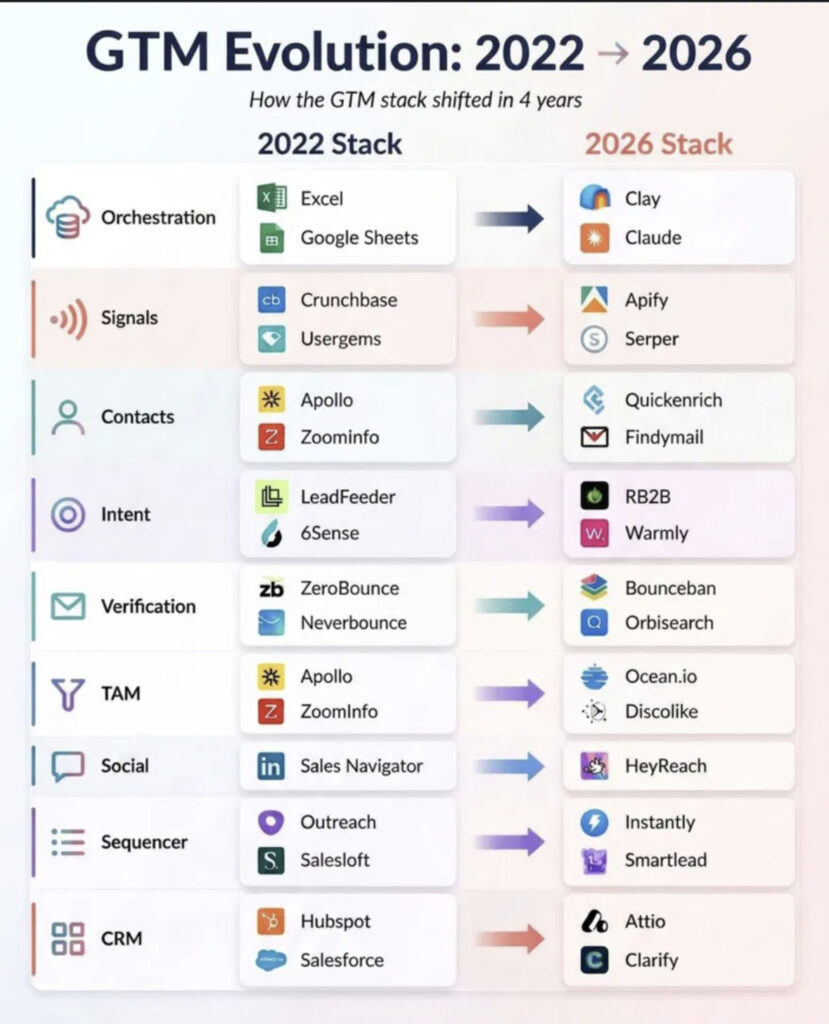
What the chart is really showing
The tempting read is “these tools beat those tools.” That read will cost you money.
Here’s the honest read: every row on that chart used to be a feature inside two or three big platforms. Now each row is its own product. Apollo and ZoomInfo were both your contact database and your TAM tool and your sequencer. Salesforce was your CRM and your reporting and your workflow engine. HubSpot was your everything.
What replaced them isn’t better software. It’s smaller software — narrow tools that do one job, expose an API, and cost $50–$300 a month instead of $30k a year.
That’s the actual story: the suite got unbundled, and the glue moved from the vendor to you.
The “Orchestration” row at the top of that chart — Excel and Google
Sheets in 2022, Clay and an LLM in 2026 — is the only row that matters strategically. The other eight rows are now commodity inputs. Orchestration is where the decisions live. In 2022, orchestration was a spreadsheet a rep updated on Fridays. In 2026, orchestration is a system that pulls from six data sources, enriches, filters, scores, drafts, and routes — continuously.
The three structural shifts that produced this chart
- The database stopped being the moat.
For fifteen years, the winning play in B2B data was “own the biggest list.” ZoomInfo built a multi-billion-dollar business on that premise. Then scrapers got cheap, waterfall enrichment became a two-click configuration, and email-finding APIs commoditized at fractions of a cent per lookup. When you can rebuild 80% of a contact database for $400 a month, nobody’s paying $40k for it.Practical consequence for you: stop paying for coverage you don’t use. Most founders under $5M ARR need a few thousand correct contacts, not fifty million mediocre ones. Buy enrichment on consumption, not on seats. - Lists gave way to signals.
This is the genuinely important one. The 2022 motion was: define an ICP, pull a list, sequence the list, burn the list, pull a bigger list. It worked when inboxes were less crowded. It stopped working somewhere around 2023, and everyone felt it as “our reply rates are dying.”Reply rates weren’t dying. Relevance was dying. Buyers got 80 identical emails a week that all opened with “I noticed you’re the VP of Ops at [Company].”The 2026 motion is: watch for a trigger, then reach out because of the trigger. New job in the buying role. Hiring for a function you serve. A competitor’s tool showing up on their site. A funding round. A specific page visited on your site three times this week. A relevant post published two days ago.Same person, same message — but sent in the 48 hours where it’s actually true. In my experience the difference between list-based and signal-based outbound is not incremental; it’s the difference between a 0.4% positive-reply rate and a 3–5% one. The tools in the “Signals” and “Intent” rows exist because that’s where the arbitrage moved.
- The bottleneck moved from execution to judgment.
In 2022, doing outbound at any real volume required people: researchers, SDRs, an ops person. That headcount was the constraint, and it’s why founder-led sales hit a ceiling around 30–50 accounts.That constraint is largely gone. Research, drafting, enrichment, list-building, and personalization can now be produced faster than you can read them. What hasn’t been automated is knowing which 200 accounts deserve attention, what to actually say to them, and what to do on the call.Which means the founder is no longer the bottleneck on volume. The founder is the bottleneck on judgment. Design your stack around that fact and it works. Ignore it and you’ll build a very efficient machine for sending irrelevant email.
Why this is unusually good news for founder-led motion
Three reasons, and they’re not obvious.
You no longer need the org to run the play. The 2022 stack assumed a team: someone to ownthe CRM, someone to build lists, someone to write sequences. A modern stack is genuinely operable by one determined person with a few hours a week. That’s a structural advantage you didn’t have four years ago.
The cost floor collapsed. A credible 2026 stack — CRM, enrichment, signals, verification, sequencing, orchestration — runs $500–$1,500/month for a founder-led team. The equivalent in 2022 was $4k–$8k/month with annual commitments. You can now test a GTM hypothesis for the price of a decent laptop.
Your unfair advantage got more valuable, not less. When everyone can generate personalized email at infinite volume, generic personalization becomes worthless — it’s table stawon’t. They’ll churn in seven months and you’ll have lost a year.kes and buyers can smell it. What still cuts through is a specific point of view about the buyer’s problem, and the person most likely to have one is the founder. The commoditization of execution makes founder insight the scarce input.
That’s the whole game. Cheap machinery, expensive judgment. Put your judgment in and the machinery multiplies it. Put nothing in and the machinery multiplies nothing.
The four traps I watch founders walk into
Trap 1: Buying the right column as a shopping list.Half those logos will be acquired, pivoted, or dead within 24 months. That’s not cynicism — it’s what an unbundled market does. Buy categories deliberately and treat vendors as replaceable. Before you sign anything, ask: if this company disappeared tomorrow, how many hours does it take me to swap it out? If the answer is more than a day, you’ve built a dependency, not a tool.
Trap 2: Buying orchestration before you have a message that works. Clay-type orchestration is extraordinary leverage — on top of a proven motion. I have watched founders spend six weeks building elaborate enrichment waterfalls before ever confirming that anyone wants to reply to their email. Orchestration multiplies whatever you feed it. Prove the message manually first, with 50 emails you send by hand and 20 calls you take yourself. Then automate the thing you proved.
Trap 3: Ignoring deliverability until it’s already broken.This is the single most common technical failure I see, and it’s silent — you don’t get an error, your reply rate just quietly goes to zero. Non-negotiables: send from secondary domains (never your primary), SPF/DKIM/DMARC configured properly, warm inboxes for 3–4 weeks before real volume, hard cap around 20–30 sends per inbox per day, verify every address before sending, and watch bounce rate like a hawk — if it climbs past ~2%, stop and fix the source. Scale by adding inboxes, never by increasing per-inbox volume.
Trap 4: The “AI SDR” fantasy. The pitch is that you can replace the human sales motion entirely. What actually happens is that you replace the thinking and keep the sending, and you end up with more volume of worse outreach, plus a damaged domain. Use automation for research, drafting, prioritization, and admin. Keep the last mile — the actual judgment about who to contact, what to say, and how to run the conversation — attached to a human. For a while yet, that human should be you.
What to actually build, staged by revenue
Don’t build the whole stack. Build the stage you’re in.
Stage 1 — Pre-$1M: prove the message, not the machine
Buy: a lightweight CRM (the modern ones are fast and cheap; don’t put Salesforce on a five-person company), one enrichment/contact source, an email verifier, an LLM subscription. Budget: $150–$400/month. Do: Build one list of 200 accounts by hand. Research them yourself. Send 20–30 emails a day personally. Take every call. Log objections verbatim in a document — not paraphrased, verbatim. The only metric: positive reply rate and, more importantly, what the replies say. You’re not optimizing conversion here. You’re discovering language. Do not buy: orchestration, intent data, a sequencer with AI features, or anything with an annual contract.
Stage 2 — $1M–$3M: instrument the signals, keep the hands on the wheel
Add: a sequencer, one or two signal sources tied to a trigger you’ve actually observed converting, website visitor identification if your traffic justifies it. Budget: $600–$1,200/month. Do: Codify the 3–5 triggers that preceded your last twenty closed deals. Go look — the pattern is in your CRM. Build one specific play per trigger. Automate the detection and the list-building; keep the writing and the calls with you. Metrics: meetings booked per trigger type, and pipeline-per-play. You’re looking for which play deserves to be scaled, and which two to kill. Watch for: your own calendar. If outbound admin is eating more than a day a week, that’s the signal to add orchestration — not before.
Stage 3 — $3M–$10M: orchestrate, then hire into it
Add: an orchestration layer, proper routing, deliverability infrastructure at scale, reporting that ties source → trigger → pipeline → close. Budget: $1,500–$4,000/month. Do: This is where Clay-type tooling earns its price, because you now have proven plays worth running at volume. Write the plays down as documents before you build them as workflows. And critically: hire the first rep into a working system, not to invent one. The most expensive mistake at this stage is hiring an AE or SDR and hoping they’ll figure out a motion you haven’t figured out yourself. They won’t. They’ll churn in seven months and you’ll have lost a year
What to keep manual, permanently
A short list I’d defend in any room:
- The first 30 seconds of every discovery call. No script, no AI notetaker summary substituting for your own attention.
- The message itself. Draft with assistance, decide with judgment. If you can’t explain why a sentence is in the email, delete it.
- Loss reviews. Read the actual thread on every deal you lose. Not a dashboard. The thread.
- Your ICP definition. Revisit quarterly, by hand, against closed-won data. Every automation you build inherits this definition; if it’s wrong, everything downstream is wrong at scale.
The uncomfortable part
Here’s what a chart like this can’t show you: most GTM problems are not stack problems.
I’ve been called into a lot of “our outbound isn’t working” engagements over twenty years. Maybe one in five was a tooling issue. The rest were positioning problems, ICP problems, or a product that solved a problem nobody had budget to solve this quarter. New tools made those companies fail faster and more efficiently.
The 2026 stack is genuinely better. It’s cheaper, more flexible, more precise, and far more accessible to a small team. It removes real constraints. But it removes constraints on execution, and execution has never been the thing that kills early-stage companies.
So use the chart as intended — as a map of where the market moved and what the categories now are. Then close it and go answer the question no tool can answer for you: why should this specific person care, right now?
Get that right and a modest stack will carry you further than you’d expect. Get it wrong and there is no configuration of nine logos that will save you.
The Monday version
If you take one action from this: open your CRM, pull your last twenty closed-won deals, and write down what was happening at that account in the 30 days before they replied to you.
That list is your signal layer. Everything else on the right-hand column is just plumbing to detect it faster.
Tool categories change every 18 months; the specific vendors named in the source chart should be treated as illustrative, not as recommendations. Pricing ranges are approximate 2026 figures for founder-led teams and vary considerably by volume and contract terms.